Tuesday, January 7, 2020

To the Last Man

It is an evening in early March, 1863. A Union gunboat stands snuggly anchored near the eastern shore of the Mississippi River. Technically it is still winter, but this is the state of Mississippi, and the evening air already holds the promise of spring.
The gunboat is about to embark on a journey upriver, but preparations are not yet complete, and as sailors throughout the vessel bustle about to finish them, two men are seated in a cabin, deeply immersed in what is plainly a very serious discussion. One of them, grizzled in appearance, looks to be about sixty years old. He wears the uniform of a Union rear admiral—he is in fact the first officer in American history to hold that rank, an honor bestowed by a grateful Congress after his brilliant and nearly bloodless capture of New Orleans, the most populous city in the rebel South.
The other man is strikingly handsome and clearly younger—about fifteen years younger, to be exact. He wears the uniform of a Union major general. His own combat record is the inverse of the admiral’s, its highlight being a humiliating defeat made worse by an adverse strategic sequel.
Each man is, of course, well aware of the other’s reputation. But the stark contrast means nothing. The only relevant fact is that the two men bear joint responsibility for an imminent, important military operation.
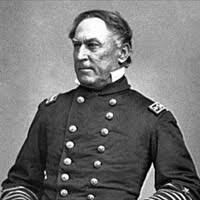
The older man happens to be David G. Farragut, who will one day be memorialized by an imposing statue in the center of Farragut Square in the nation’s capital. He is a career naval officer who has almost literally known no other life, having entered service as a midshipman at the age of nine.
The younger man is Nathaniel P. Banks, bereft of military service until the outbreak of the war, but with a political career behind him that, in terms of success, handily outstrips that of Farragut’s own pre-war career, which is so straightforward it’s scarcely worth mentioning.
But at age 32 Banks had won election as a representative in the Massachusetts state legislature. Just two years later he took up the gavel as Speaker of the Massachusetts House of Representatives. Two years more saw him win election as a representative to the U.S. Congress, and barely a year later, at age 40, through a combination of luck and skill, he became Speaker of the House, among the youngest Speakers in American history. He the won three terms as Governor of Massachusetts and easily won re-election three times. Then in 1860, at 44, he traded politics for a more lucrative career as resident director of the Illinois Central Railroad. A year later that career ended abruptly with the outbreak of the Civil War.
Banks almost immediately vaulted into the rank of major general of volunteers, an utterly bizarre development by present-day standards, but then few present-day standards applied to the early days of a crisis utterly unprecedented in American history. President Abraham Lincoln firmly believed that success depended upon strong public support for the Union cause, and a good way to ensure this was to make generals of men like Banks—in the case of Banks specifically to ensure the allegiance of the populous state of Massachusetts. His extensive political connections, acquired during the course of his meteoric political career, were a nice bonus.
There might have been a second reason to promote Banks. The Civil War was precisely that—a civil war—and as Union armies conquered Confederate territory their very success would require men equal to the problematic task of administering territory that must, after all, be restored to the Union, and that restoration was the entire point of the Union war effort. The complexity of this task should not be underestimated. A brilliant admiral like Farragut, although an expert at navigation at sea, would not have the slightest idea how to navigate the swirling political waters of wartime administration.
Banks, like Farragut, is now memorialized by an equally imposing statue in the heart of Boston. The statue memorializes his peacetime political career, of course, but with equal validity it could memorialize his service to the Union as military administrator, which in its own way would contribute as much to eventual Union victory as Farragut’s naval genius.
But the moment of that victory, as the two men confer about the impending operation, is unknowable. It may lie two years in the future, or five, or perhaps a whole decade. All they know is that the United States has been torn in two by a political disaster.
It was a political disaster that a few Americans had threatened it, or warned about it, for decades. But few really believed would actually happen, not even during the 1850’s, a decade that had seen a number of major crises centered on one basic question: was the American republic a free republic with pockets of slavery, or a slave republic with pockets of freedom?
Politicians showed themselves unable to resolve the question through the ordinary give-and-take of politics. A famous historian will one day dub them, collectively, as “the blundering generation.” Banks, strictly speaking, is a member of that generation. Certainly he saw much of the blundering at close range, thanks to his years in Congress.
Of one thing, however, both men are certain: the Union must be restored.
And as they uncork a bottle of champagne and share a glass or two, Farragut articulates the price to be paid if necessary.
“What matters it, General, whether you and I are killed or not? We came here to die. It is our business and must happen sooner or later. We must fight this thing out until there is no more than one man left and that man must be a Union man.” He briefly lifts his glass: “Here’s to his health.”

Sunday, January 5, 2020

The Rebel Jesus

[This is a portion of much longer post I composed on "Blog Them Out of the Stone Age," the blog that put me on the map, as it were. In fact it was this post that actually did it, because it brought me to the notice of a much larger blog, who in effect told its readers, "Hey, check out Grimsley's blog; it's interesting." That occurred about a year after I labored in near total obscurity." I wrote a posted it on December 23, 2004, two days before Christmas. The illustration, incidentally, is of the logo I used for the blog.]
One of the beauties of scholarship is that it's a collaborative enterprise: a community of those dedicated to the life of the mind. Members of that community should listen to the voices of everyone in it but nobody can adopt all the potential postures and points of view at once. I'm trying to expand my ability to listen, yet I know that at the end of the day, temperament if nothing else will draw me back to what for me is an instinctive itch to build bridges of communication between people who don't usually talk to one another. Among other things, that means I'll probably never adopt an antiwar perspective so strongly as to reject engagement with the strategic policy-making community.
All the same, the older I get, the more I question the things I was raised to believe, especially the idea that war is legitimate, but also the idea that the United States is all about truth, justice, and a square deal for everybody. The United States is, like any other society, a community of flawed human beings. Its government, like every other government, tends in aggregate to manifest a lower degree of morality than its component individuals. I'm firmly with the Christian theologian Reinhold Niebuhr on that one. Somebody once asked him about the title of his most famous book, "Moral Man and Immoral Society." Niebuhr replied that, strictly speaking, it should have been" Immoral Man and Even More Immoral Society."
Of course, as soon as I say that I'm reminded that you can't breathe a word of criticism, in some quarters, about our policies and their effects without being told that you don't love your country and you must be one of the "blame America first" crowd. Too many Americans on the left and on the right have raised to an art form the instant putdown and the ad hominem attack. I'm too much of an historian to believe that things used to be better--after all, I cut my teeth on the Civil War. All the same, the quality of public discourse could stand much improvement.
I'm heartily tired of the Jane-you-ignorant-slut, you-shot-my-dog, you-fucked-my-wife tone of what passes for political discussion in most TV and radio talk shows and most books and articles dealing with current affairs. I can't decide which I hate the worst: people who talk that way because they mean it or people who talk that way as a kind of performance art. The other day I stumbled across a FOX News round table discussion--it may have been "Hannity & Colmes", because I remember seeing Colmes--in which the participants were batting around the recent Mosul attack as if it were a beach ball. I'm serious. They were smiling and having a gay old time.
And there were good men dead.
And millions of lives in the balance.
And we're getting to the point--hell, we're well past it--where we think that kind of gabfest is okay.
I'm not sure that I'll get a chance to post another entry before the holiday, so I'll take this chance to wish everyone a merry Christmas (or to hope that you have/had a happy Hannukah, joyful Kwanza, contemplative Ramadan, or dysfunctional Festivus).
I leave you with the lyrics of a song that seems appropriate to both the season and this entry. They're by Jackson Browne.
THE REBEL JESUS
Original recording from the Chieftain's album "The Bells Of Dublin"
The streets are filled with laughter and light
And the music of the season
And the merchants' windows are all bright
With the faces of the children
And the families hurrying to their homes
As the sky darkens and freezes
Will be gathering around the hearths and tables
Giving thanks for all God's graces
And the birth of the rebel Jesus
They call him by the "Prince of Peace"
And they call him by "The Saviour"
And they pray to him upon the sea
And in every bold endeavor
As they fill his churches with their pride and gold
And their faith in him increases
But they've turned the nature that I worshipped in
From a temple to a robber's den
In the words of the rebel Jesus
We guard our world with locks and guns
And we guard our fine possessions
And once a year when Christmas comes
We give to our relations
And perhaps we give a little to the poor
If the generosity should seize us
But if any one of us should interfere
In the business of why there are poor
They get the same as the rebel Jesus
But pardon me if I have seemed
To take the tone of judgement
For I've no wish to come between
This day and your enjoyment
In this life of hardship and of earthly toil
We have need for anything that frees us
So I bid you pleasure and I bid you cheer
From a heathen and a pagan
On the side of the rebel Jesus.
(c) 1991 BMG MUSIC

Political Autobiography: A Tool For Dialogue

[This entry was originally published on "Sibling Rivalry," a blog my brother Scott and I maintained during the 2016 election year.]
I have a deep personal desire, need might be the better word, to find a path to constructive political dialogue. At the same time I have increasing doubts about my ability to do this and whether attempting to do so is a good use of my time.
But rather that rattle off the list of doubts, let me hit this from a different angle. What would be the features of a constructive dialogue?
The first thing is that it cannot be a debate, because a debate is fundamentally about winning and losing. The dialogue has to be based on mutual curiosity: I want to understand your point of view, not convert you to mine.
It can't focus too quickly on political issues, either. A person's stand on a specific issue is an extrapolation of their basic world view. If two people have different world views then they necessarily approach any given issue from two points of departure--different priorities, different ideas about how the world works, different definitions of crucial concepts ("freedom," for example). They will almost certainly talk past one another. Worse, they're quite likely to end up arguing, in effect, that my world view makes sense and yours doesn't.
So the first main feature is a basic understanding of each other's political worldview. Therefore my usual practice, whenever possible, is to ask people to offer their political autobiography, although I usually find a way to ease them into offering it rather than to ask directly. By political autobiography I mean the basic values and life experiences that created their political perspective. Many people are happy to tell me. Some are not. With regard to those who aren't, my impression is that they feel defensive or embarrassed. What if they sound silly or naive? What if they can't readily say how they came to believe what they believe? What if they've never even thought about it?
It isn't necessary to view the skittish ones as not worth talking to. But for the time being it's best to talk about something other than politics.
It can be useful to give one's political autobiography first. It's easier for other people to show vulnerability if you're willing to show some vulnerability and it provides a model for them to follow.
So by way of illustration, I'll give you my own--some of it anyway--as nearly as I can make it out.
I grew up in North Carolina in the 1960's. My parents were both Democrats. The martyred president John F. Kennedy was a personal hero of mine and at age 8 I thought I bore a close resemblance to the way he looked at age 8. Given that I harbored political ambitions in my youth, this seemed to be a good augury. (It did not occur to me that my own family was bereft of the wealth and built-in connections to the power elite that made JFK's political ambitions a good deal more realistic than mine.) I agreed with everything I understood JFK to stand for, which to my mind basically meant a commitment to civil rights, a concern for ordinary people, an optimism about America and--perhaps most fundamentally--a belief in the power of government to do good.
I also imbibed the view that the term "liberal" meant "available to reason." I'm not sure where that came from. But when my daughter Chloe and I happened to watch Guess Who's Coming to Dinner the other night, I instantly realized that as a child I had been powerfully impressed by Matt Drayton (Tracy Spencer) and Christina Drayton (Katharine Hepburn). Certainly, as a young white Southerner I had fully understood (as Chloe could not, without considerable explanation from me), how it would pose a dilemma for the Draytons when their daughter Joanna (Katharine Houghton) showed up to announce that she was going to marry a black physician (Sidney Poitier). But Christine's comment to Matt made perfect sense to me:
She's 23 years old, and the way she is, is just exactly the way we brought her up to be. We answered her questions. She listened to our answers. We told her it was wrong to believe that white people were somehow essentially superior to black people—or the brown or the red or the yellow ones, for that matter. People who thought that way were wrong to think that way. Sometimes hateful, usually stupid, but always wrong. That’s what we said, and when we said it, we did not add, “but don’t ever fall in love with a colored man.”
That was liberalism as I understood it. Anyone who felt otherwise was simply crimped and closed-minded. My agreement with Christine Drayton did not mean, of course, that I did not harbor a deep reservoir of racist views. No white child born in the Jim Crow South--even in the final years of its existence--could escape that dubious birthright. Nor did my agreement mean that I would have approved the match had Joanna's choice fallen upon anyone but a black man of consummate achievement, good looks and winsome charm, who dressed like a WASP, talked like a WASP, and had a physiognomy not far removed from a WASP. My point, however, is that I didn't grow up thinking that racial prejudice was OK or justifiable.
As I learned American history in middle school and high school, the Gilded Age made a huge impression on me. Standard Oil, US Steel, and the railroads did everything they could to eliminate competition, exploit labor, and rig the economy to favor themselves. And I thought of government as the only entity bigger than the great corporations. I never thought of government as somehow being inherently in opposition to the people. That still strikes me as a strange idea. I thought of government as Lincoln did: "of the people, by the people, and for the people." To me it was a good thing that through government we could restrict child labor, bust trusts, give the ordinary joe a 40-hour work week, and create regulatory agencies to ensure that businesses sold wholesome food.
Basically, there are always bullies and enemies and challenges big enough to defeat any ordinary person. Therefore the only way that ordinary people can prevail is by banding together. That's why I have always believed in good government and labor unions and collective bargaining.
I understand that government can be inept or corrupt or tyrannical. I'm an historian, for crying out loud. But the famous declaration by anti-tax crusader Grover Norquist--"I don't want to abolish government. I simply want to reduce it to the size where I can drag it into the bathroom and drown it in the bathtub"--strikes me as so absurd it fails even as humor.
You can see already that it would be a sterile exercise for me to "debate" a specific issue with someone who was fundamentally suspicious of government. Our points of departure would be hopelessly far apart. Before we could get anywhere, we would have to explore the reasons for my basic faith in government and his basic lack of faith.
Let me end here. The story is incomplete but by now you have the idea of what a political autobiography looks like. It doesn't need to be sophisticated. In fact, if it's sophisticated it's somewhat suspect, because our basic world views are, in the nature of the case, simplistic, naive, and incomplete when they first emerge. But they stick with us, and they exert a powerful grip.

Are You Nuts?


The short answer is no.
But here’s the reason I am asking this rhetorical question: although many people are aware that I have bipolar disorder, a surprising number have scant conception of what it means. An extreme example occurred when I was watching football and the team I was rooting for scored a touchdown. A friend evidently thought that I celebrated too enthusiastically (which was probably true), and on that basis concluded I must be manic.
I didn’t mind (much): she wasn’t being mean about it, she was concerned about me. And concern for a friend is always appropriate. Yet this anecdote illustrates one of the realities of having bipolar disorder and having people in my life who don’t know much about it. People in effect think that you can never just be normally happy or sad. Everything you do or say can be pathologized.
During the weeks to come you’re going to see a flurry of activity that may animate fears that I may be hypomanic. And you may also see me publishing entries that appear to bear little relationship to one another, which may also excite concern that I’m a little off my rocker.
Let me do the best I can to explain why you shouldn’t worry.
First and foremost, this year I’m eligible for a Faculty Professional Leave; what in layman’s terms would be called a sabbatical. The deadline for applications is January 17, which gives me just twelve days to put together a proposal that’s likely to pass muster. Typically FPLs are routinely granted, but if it looks as if I’ve abruptly shifted from one book project to another without good reason, that may cause the evaluators to balk.
Second, if that occurs, and the department thinks I’m screwing up—well, although I’m protected by tenure, it turns out that I’m not protected from having my course load raised from four courses to six, which is the academic equivalent of being exiled to Siberia. That’s a worst case scenario, but in my experience worst case scenarios can sometimes turn into worst case realities.
Third, historically I have used the flexibility of social media to conduct work in ways not possible via traditional means. One advantage is that it annihilates the vast time from the time I write something to the time someone reads it, which means social media affords a medium in which I can receive feedback as I go along, and frankly the encouragement on which I thrive. Another is that it permits methods of laying out material that are impossible via ordinary means: in effect of teaching more effectively. One example is the ability I have to link to a performance of “Daylight Again/Find the Cost of Freedom,” which includes lyrics that speak directly to the central theme of the book:
I think I see a valley
Covered with bones in blue
All the brave soldiers that cannot get older
Have been asking after you
Hear the past a-calling
From Armageddon's side
When everyone's talking and no one is listening
How can we decide?
Next, it forms a convenient place links to articles, etc. that I may want to use in the conventional manuscript.
I could go on, but you get the idea.
It may also relieve your mind to know that in the past few days—that is, since I decided to make this a book—I’ve touched base several times with my therapist; and she thinks I’m not only “normal” but that my enthusiasm for this project is very good for my mental health.
So there!

Saturday, January 4, 2020

I'm Scared Shitless When a Plan Comes Together

Today was a good day in terms of the book, despite writing a preface that came off like something Marianne Williamson would use to wipe her butt. But getting wrong can carry you a long step toward getting it right, and the mishap ended up greatly illuminating the book’s content and structure, among other things. It also made me realize that, taken on the whole, I actually knew what I was doing. And that serendipity had been strongly asserting itself. For the first time I have a glimmering that I can actually pull this thing off. As someone with bipolar disorder, the thought was both liberating and terrifying.
On “The A-Team” Hannibal Smith invariably grins at some point in the show, cigar clinched in his teeth at a jaunty angle, and declaims, “I love it when a plan comes together.” But an evolving hypomanic episode brings about an irresistible sense that the whole universe is coming together, and a giant sense of possibility emerges that some window of opportunity has come about—but also the sense that the window will close unless you drop everything to dive through it.
Fortunately I felt none of those things today. And when your strongest impulse is merely to crack open a pale ale, and when you’re so tired you have trouble even staying awake, it’s a pretty clear indication that you’re safe.

The Dead Are Never Dead

“Today was busy wall to wall: far too hectic to craft a substantive entry,” I wrote last night. “And yet I feel somehow that I can't just skip a day, whereas just a few days ago I would have had no problem with doing so. That means something. I don't yet know what.”
Well, I now know what. It came to me as soon as I awoke.
I am still my father’s son.
I’m not going to get mushy about this, because Dad never wanted me to get mushy about anything. In the immediate aftermath of my manic episode in September 1986—the one that, among other results, led my employer to immediately fire me lest I axe murder his family—I was destitute and for a few months had to go live with my father and step-mother.
During that time I met a psychiatrist several times. I recall his name but nothing else about him except that he made one of the most astounding statements I ever heard. I was at a session whose purpose was to take a detailed history of me, The task included a lot of questions concerning my childhood which, not to put too fine a point on it, did not much resemble the childhood which Katherine (my daughter’s mother) and I have made it our business in life to provide for our daughter Chloe.
After the psychiatrist had asked questions for about fifteen minutes, he paused to say that my “affect” and the things I was describing did not line up. I seemed out of touch with my feelings.
When I got home after the appointment my father was there. I told him briefly about the appointment—very briefly, because his demeanor suggested that he was not all that interested—and then related with a kind of pride the psychiatrist’s opinion that I seemed out of touch with my feelings. I thought my father would surely approve of that.
Well, not so much.
He said that in his opinion I was morbidly in touch with my feelings already.
That was the beginning of a new wisdom for me. I suppose, in a sense, it was also the day I embarked upon a journey that has sent me many places, shown me many things, had its moments of glory and hardship and emptiness, and finally brought me to this place, on the cusp of writing a manuscript that many people will regard as kind of gonzo. So be it. I am not quite certain how I am going to do this, but I am now quite certain why I am doing this.
I have mentioned before that my first and perhaps only claim to professional fame is my first book, “The Hard Hand of War.” The book received very strong reviews. One critic called it “one of the best books of Civil War military history published in twenty-five years.” Another wrote, “Grimsley’s evaluation of the Union’s evolving policy toward Confederate civilians is detailed, balanced, and persuasive. His prose is taut and polished, his research impressively thorough.” You get the point.
But the best and most perceptive review of the book came from my sister, who said it was an allegory of our parents’ marriage.
In my late 30’s I relayed this to my therapist and she said that my sister was correct, that the book was centrally concerned with finding a balance between justice and power and that, given my childhood history, it was natural for me to have selected a project that allowed me to explore that.
After hearing her explanation its truth seemed obvious. Among historians, out of the endless array of research problems we could choose, what causes us to select one in particular? I suppose it’s possible that an historian could select a project for purely intellectual reasons—I’m certain that it’s possible they might think that’s what they’re doing—but I think we choose research problems that speak to us personally, in some deep way that may forever lie outside our conscious awareness but that nonetheless animates our quest.
In the case of “The Struggle for Peace,” the source of my compulsion is obvious.
It comes from 22 years of observing two people, fruitlessly in the end, struggle to build a love between them that both so desperately needed. The analogy between that dynamic and the toxic hyper partisanship that characterizes contemporary politics is so blatant that no one could miss it.
I said at the beginning of this entry that I had figured the root of my strange compulsion to knock out at least some sort of entry for yesterday. It was simple. My father would have expected it of me.
I don’t think in a million years my father would have approved of this project—or more precisely, of the way I am handling it, which is to say to pursue it in my own way, using my own voice so blatantly, drawing upon my life experiences so heavily, and, for pity’s sake, coming across as so emotional about it (which is a deliberate narrative strategy, in case you’ve been starting to squirm).
But my father would have insisted that, having embarked on this project, I must execute it responsibly and professionally. On countless occasions, seeing him trapped between weariness and tasks still to be done, he always chose to finish the tasks. He was just that kind of man.
The dead are never really dead. Not as long as we remember them. Not as long as they retain the power to touch our lives.

Friday, January 3, 2020

Night of the Weary Prof

Today was busy wall to wall: far too hectic to craft a substantive entry. And yet I feel somehow that I can't just skip a day, whereas just a few days ago I would have no problem with doing so. That means something. I don't yet know what.
The only news of consequence is my creation of a blog to support this project. The Facebook platform is great for feedback: people can easily "like" a particular entry or leave comments. What they can't do is easily go back to previous entries. Hence the blog, imaginatively titled “Struggle for Peace,” which is perfect for the job. You’ll find the link elsewhere on this Page
So far I've only copy/pasted two entries, just to gauge time required to do the whole job. Happily, the answer is that it's a breeze.
I did find time to stop by my campus office to raid it for several books related to this project. If it weren't so cumbersome I could have brought several more.
The visit, brief as it was, put me in no doubt that there's *a lot* of literature that is potentially relevant to the book. And by extension, an urgent need to establish parameters that will make the book both valuable and manageable.
OK: that's all I got for today. I'm wiped out. But tomorrow is another day. Shit: it's now past midnight. *Today* is another day.