Saturday, November 2, 2019

The Wicked Wit of Rush

Here’s the promised post on Rush Limbaugh’s humor. Some of you will not find it very humorous, I’m afraid.
Each weekday at noon, hundreds of radio stations across the country broadcast a heavy bass riff, instantly recognizable to millions of listeners, most of whom have no idea that It’s the riff that opens “My City Was Gone,” a 1982 hit by the Pretenders lamenting what urban sprawl had done to the area around Akron, Ohio, the home town of lead singer Chrissie Hynde. The last stanza conveys the spirit of the whole:
I went back to Ohio
But my pretty countryside
Had been paved down the middle
By a government that had no pride
The farms of Ohio
Had been replaced by shopping malls
And Muzak filled the air
From Seneca to Cuyahoga Falls
Said, ay, oh, way to go, Ohio
The lyrics carry unintended irony in view of the song's appropriation by someone who has no problem at all with big business devouring all in sight.
Because after about 40 seconds, the bass riff disappears and instead one hears a commanding voice announcing another edition of “The Rush Limbaugh Show,” part of the (fictional) EIB Network and the beating heart of the (fictional) Institute for Advanced Conservative Studies. The voice of course belongs to Rush Limbaugh, by far the most famous radio talk show host in the country and, for that matter, one of the most familiar names in the country—certainly with any American political junkie.
Over the course of his four-decade career, Limbaugh has evolved into arguably the most powerful person in politics who does not hold public office, and indeed he is more powerful than most of those who do. His popular image is that of a relentless enemy of left wing America, which is true enough. But unless you listen to the show, you have no idea that he has a wicked sense of humor and can be very funny—although this was far more true a decade ago than it is now.
Media critic Brian Rosenwald, author of a superb new book on political talk radio, argues that Limbaugh’s sense of fun was a major reason for his early success.
“At the outset, Limbaugh wasn’t angling to become a political force—he was there to entertain and make money. Limbaugh’s show departed from the staid, largely nonpartisan, interview and caller-based programs that were the norm in earlier talk radio. Instead, Limbaugh was a consummate showman who excited listeners by being zany and fun and obliterating boundaries, offering up something the likes of which many Americans had never heard before.”
Rosenwald goes on to describe some of Limbaugh’s antics. Scornful of the way that liberals seemed to idealize Soviet leader Mikhail Gorbachev for his role in ending the Cold War, Limbaugh called liberal expressions of adulation “Gorbasms,” and the pronouncement of a Gorbasm was followed by a cut from Star Wars’ ”Imperial March” (better known as the Darth Vader theme). Stories about animal-rights activism triggered a mashup of Andy Williams’ “Born Free” with, as Rosenwald describes it, “machine gun blasts, mortar explosions, and screeching animals.”
Limbaugh broadcast a parody song about Senator Ted Kennedy entitled “The Philanderer,” to the tune of Dion’s 1961 hit “The Wanderer.” He coined acid but witty nicknames for any figure who displeased him. Democratic Senate Majority Leader Harry Reid, for example, was invariably called “Dingy Harry.”
I tuned in regularly to “The Rush Limbaugh Show” during the Clinton Administration, a period in which Limbaugh opened each broadcast by saying that it was Day [insert number here] of “America Held Hostage.”
With few exceptions I can’t recall specific antics, but a lot of them were laugh out loud funny and redolent with irreverent humor—which happens to be my favorite form of humor, especially when it is outrageously irreverent.
But the show routinely flirted with the boundary between what was offensive but funny and what was just plain offensive, and I happened to be listening during one of the most famous instances of the latter.
It happened in late 2007, on the verge of the 2008 Democratic Primary season. The adulation accorded Barack Obama in some circles was mocked by an Al Sharpton impersonator who sang “Barack the Magic Negro” to the tune of “Puff the Magic Dragon."
Here are the lyrics in full:
Barack, the Magic Negro
Lives in DC
The L.A. Times, they called him that
'Cause he's not authentic like me.
Yeah, the guy from the L.A. paper
Said he makes guilty whites feel good
They'll vote for him, and not for me
'Cause he's not from the 'hood.
See, real black men, like Snoop Dog,
Or me, or Farrakhan
Have talked the talk, and walked the walk,
Not come in late and won!
[Refrain] Oh, Barack the Magic Negro, lives in D.C.
The L.A. Times, they called him that
'Cause he's black, but not authentically.
Oh, Barack the Magic Negro, lives in D.C.
The L.A. Times, they called him that
'Cause he's black, but not authentically.
Some say Barack's "articulate"
And bright and new and "clean."
The media sure loves this guy,
A white interloper's dream!
But when you vote for president,
Watch out, and don't be fooled!
Don't vote the Magic Negro in -
'Cause -
[Spoken] 'Cause I won't have nothing after all these years of sacrifice, and I won't get justice. This is about justice. This isn't about me, it's about justice.
It's about buffet. I don't have no buffet and there won't be any church contributions, and there'll be no cash in the collection plate.There ain't gonna be no cash money, no walkin'-around money, no phone-in money.
***
The song created a tempest in the media, which pleased Limbaugh no end. And I’d bet real money that most of Rush’s listeners laughed their asses off.
The end of this post pretty much forces me to focus the next column on the racism that lies just below the surface of Limbaugh’s broadcasts—and in this case, of course, broached the surface outright.

Friday, November 1, 2019

That Noble Dream?

Another busy day--and long. As I write this it's a bit after midnight. I meant to knock out this post three hours ago, when it was still November 1, only to fall sound asleep in front of the laptop.
Among my tasks today--or rather, yesterday--was a trip to campus for my first appointment with a personal trainer at Ohio State's RPAC (Recreation and Physical Education Center). I'd scheduled the appointment for 1 pm, so that en route I could catch the first half hour of The Rush Limbaugh Show.
In stark contrast to yesterday, El Rushbo was in in fine feather today, chiefly because Trump has announced his attention to shift his legal residence from New York to Florida, a move Rush himself had made many years before. He reminisced happily about how he'd left New York and its high income tax (8.82 percent) to relocate to Florida (no income tax at all--nor, for that matter, any property tax). To hear him tell it he had royally screwed over the Empire State, and the fact the President was now emulating him delighted Rush no end.
But that's all I can tell you about today's broadcast, because I had that appointment to meet. And anyway I promised that today's post would focus on placating the notional visitor to the OSU history department's Facebook page, complaining that in reprinting my posts the department was guilty of partisanship, because *I* was guilty of partisanship.
Well, notional visitor, you know not whereof you speak.
Oh, I get it: you think I should be nonpartisan, and discussing the rise of conservative media is somehow intrinsically partisan. But consider what you're thinking. I mean, at some point historians will analyze the subject precisely for the reason I'm doing--it's an important development in the recent history of the United States. So at what point will enough time have passed before it becomes possible to treat this phenomenon objectively?
Never.
Never ever will it be possible to treat this--or *any* historical phenomenon--objectively.
Because objectivity is a will o' the wisp, what one historian has termed, in a famous phrase, "that noble dream."
Oh sure, you can *try* to be objective, but in the nature of the case you have to make choices about the selection and weighting of evidence, and you will make them based on a number of subjective factors: your basic beliefs about how the world works, the influence of contemporary events on how you interpret historical events that seem analogous, and a dozen other factors, all adding up to the fact that you will inevitably approach historical events subjectively.
The best you can do is strive for objectivity, but that striving will be both futile and kind of naïve. What you're really trying for is "the God trick," also known as "the view from nowhere."
No, you can't be objective, but you can be honest. You can confess to your readers that your analysis is inherently going to be subjective. But that doesn't mean partisan or polemical. You can operate from a stance of intellectual curiosity. Sure, you might be a lifelong Democrat dismayed by, say, the Reagan Revolution. But you can still choose to view it as a major historical development and set aside your personal views in favor of understanding it on its own terms. Or, to put it more eloquently:
"Concerning issues of objectivity and partisanship, I firmly believe that it is possible for a historian to lay aside personal views, commitments, and earlier judgments when writing about the recent past--including events in which he or she has had a small hand. Judging the past scrupulously requires a willing suspension of one's own beliefs. No historian is perfect at it; it is an elusive, even impossible goal but also an essential one if history itself is to be more than propaganda, more than a reaffirmation of one's own prejudices. Indeed, one of the most satisfying if humbling aspects of writing history is to find one's prejudices and expectations challenged by the historical record and sometimes undone, as has happened to me repeatedly in writing every chapter of this book." [Sean Wilentz, The Age of Reagan: A History, 1974-2008 (New York, HarperCollins, 2008), 10-11), 10-11.]
OK. Whatever. But why are you talking about yourself driving down a highway listening to Rush Limbaugh?
Because I'm employing a literary technique called placing oneself in the narrative.
Now shut up and let me get on with the story.

It's All Fun and Games Until Somebody Loses Tenure

By last evening I was completely blown out on the trail, and while composing a take home essay prompt for my students’ upcoming midterm, I alternated between writing gibberish and dozing off. The task took me at least twice as long as it should have done, but I finally completed the job, and feel reasonably confident that it’s coherent. If not I should get some very interesting student essays.
Once again I have to postpone explaining how El Rushbo used to be fun, because something interesting has cropped up. Yesterday I chanced to have a conversation with the staff member who handles the OSU History Department’s web site and social media accounts, and happened to tell her about this new page. She said she’d like to share them to the Department’s own Facebook Page—unless they were political.
Naturally I said that they were. But she soon clarified that she meant *partisan* political, whereas I see myself as writing political history. Of course, it’s contemporary political history, to say the least. Or maybe not. The starting point for my maiden post on conservative media was about 1975–or let’s call it 1977 in honor of my high school graduating class. That’s 42 years ago. Rush Limbaugh’s radIo career began even earlier, and he first came to prominence in 1990–29 years ago.
On top of that, as I’ll eventually convey, the roots of conservative media actually go back to the 1930s.
Nonetheless, whenever a partisan post inadvertently appears on the OSU History Page, someone calls to complain and the post has to be deleted. So in order to quell the skepticism of some reader who just ain’t buying it, let me talk a bit about the challenges of writing the political history of comparatively recent events.
But since I have a policy of keeping the word count of these posts to about 600 words (on the theory that too many readers would bypass something longer), I’ll defer that discussion to my next post.

Wednesday, October 30, 2019

Ask Your Physician if Rage is Right for You

It’s been a long day and I have neither time nor energy to tell you tonight of the good old days when Rush was fun to listen to.
But I can relate that I tuned in today en route to campus and El Rushbo was angry from the word “go.” I couldn’t stay focused on the content of his broadcast, although I did manage to learn that “environmental wackos” are the true culprits in the California wildfires, and that “act of God” is the California liberals’ only form of acknowledgment that God exists.
Instead I found myself pondering his tone, which was one of continuous, sputtering, indignant rage. I wondered how anyone could endure listening to such a tone for three solid hours.
I tried a thought experiment. We’ve all had the experience of being treated badly, telling a friend about it, and hearing them get angry on our behalf. “That stinks! Of all the nerve! How dare that bastard say such a thing to you! What a complete asshole! I’d like to give them a piece of my mind!”
I know it can feel good when someone becomes indignant for my sake. It’s a straightforward, unadorned validation that I actually matter.
But suppose my friend was still erupting with righteous fury an hour later? Would it still feel good?
I mean, past a certain point, isn’t it painful to be in the presence of an angry tone of voice, even if it isn’t directed at you—even, indeed, if it’s an angry tone enlisted on your behalf?
I couldn’t imagine being comfortable around a devoted friend who maintained such a tone, much less choosing to tune in specifically to hear it.
And yet millions of people not only *can* imagine it, they regularly make it part of their day.

Monday, October 28, 2019

The Birth of Modern Talk Radio


I spoke before about the crisis on the AM dial: the way in which its audience, interested mainly in popular music, forsook AM radio for the better quality reception offered by FM. AM stations urgently needed a new format that would grab listeners. It found one in the form of talk radio.
Talk radio was nothing new. There was “The Larry King Show,” for example, which hit the airwaves in 1978 and rapidly acquired a wide following, including my father, who was often still wide awake after the TV stations had signed off for the evening. “The Larry King Show” suited him perfectly because it aired from midnight to 5:30 a.m. He’d listen to it in the dark until he finally dozed off.
King’s epitomized what was then the most common talk show format, which he did better than anyone else. During the first hour of the program he’d interview a guest—frequently the author of some recent arresting book—and do so in an affable style based upon genuine curiosity. Convinced that King was really interested in getting to know them, guests were often utterly disarmed and therefore more candid than they might otherwise have been. This knack was a key to King’s success—a knack he eventually carried to television once cable news entered the scene.
After the first hour, King continued the interview for two more hours but invited callers to participate, which they did in droves. At 3 a.m. he excused the guest and engaged directly with callers for the rest of the show, usually signing off with a brief, middle-of-the-road political commentary.
My father liked King because he made good company. He also said that he usually learned something from the show, and he appreciated that.
“The Larry King Show” (which ultimately reached 500 markets) offered one model of an effective talk show format. But the one that ultimately proved most relevant to conservative talk radio was an offshoot of the durable “Morning Zoo” format which dominated the air waves as listeners got ready for their day and hit the road for the weekday commute. The Morning Zoo was (and remains) a hybrid between talk and music. DJs would spin the occasional platter but they spent a lot of air time cracking wise with each other, pulling various stunts—the surprise prank call to some bewildered soul was a source of cheap, reliable fun—and in general affecting a zany atmosphere with an irreverent style of humor.
This gave rise to the “shock jock,” who jettisoned the music and pushed the Morning Zoo format as hard as it would go. Unlike King, shock jocks thrived on controversy and tested the limits of what they could get away with short of costing a radio station its license. The master of this format was Howard Stern, who honed his craft locally starting in 1975—moving several times to stronger markets—and took “The Howard Stern Show” nationwide in 1986. In tandem with sidekick Robin Quivers, Stern eventually reached an audience of 20 million listeners—and incidentally cost his station licensees $2.5 million in fines from the Federal Communications Commission.
Then there was Don Imus, another shock jock whose “Imus in the Morning” premiered in 1968 and acquired a nationwide audience during its 36 years on the radio (plus another 11 on cable TV). While abjuring Stern’s lusty embrace of being a thorough-going asshole, Imus had a crusty style and was an inveterate contrarian. He eventually shifted to an emphasis on news and politics—but not before the appearance of the main savior of AM radio: the redoubtable Rush Limbaugh, El Rushbo, founder of the EIB (Excellence in Broadcasting) Network for Advanced Conservative Studies, with half his brain tied behind his back just to make it fair.
Rush will dominate the next several installments of this effort to comprehend conservative media, but don’t lose track of his progenitors: King, Stern, and Imus. They knew how to entertain listeners day after day, for hours on end. Limbaugh took their genius and transferred it to politics.

Sunday, October 27, 2019

Tune In for Crisis on Your AM Dial


If you bought a car in the 1950’s, 60’s, or 70’s, this is what your radio would look like.
It’s the point of departure for understanding the rise of conservative talk radio, and I’m realizing with horror that if I were to give a lecture on the subject to my undergraduates, I’d have to spend five minutes explaining how this thing worked.
But the key thing is that you’re looking at an AM radio, and AM radio basically sucks, at least if you want to listen to music. The Beatles, Beach Boys, Led Zeppelin, Elton John—90 percent of the time we got our first introduction to their music via the monaural speaker of an AM car radio. It was cool but only because we didn’t know any better: you’d put up with the static and the mediocre sound quality and save the quality listening experience for your record player at home.
If you were at home you could also listen on FM, whose sound quality was a lot better, had very little static, and could broadcast in stereo. But for reasons I don’t really understand FM didn’t work well in automobiles. In most makes and models they weren’t a standard accessory even if you could get one.
But eventually—the early 1980s or thereabouts—FM radio became common in automobiles. Given a choice between listening to music in AM or FM there was no contest. It was FM, hands down. No static at all, as the Steely Dan song put it.
That left a lot of AM radio stations high and dry. They had to figure out a way to stay alive. Some of them didn’t. Others limped along, often in an Easy Listening format. It was sad. But AM could still do one thing as competently as FM: it could broadcast a human voice. And that’s how talk radio became a staple on the AM dial. Not conservative talk radio—that’s not yet part of the story. But without the eclipse of AM by FM in American automobiles the story doesn’t begin.

Saturday, July 30, 2016

Caught in the Cross Fire: A Visit to Lynndie England's Hometown


The following is a re-printed post I published twelve years ago, back when this blog was in its infancy and entitled Interrogating the Project of Military History.  The post was originally entitled "Drive-by Journalism," but since Rush Limbaugh long ago adopted "the drive-bys" as an epithet for mainstream media journalists, I felt obliged to change it.  This is one instance, though, when the term seems entirely appropriate.


June 7 [2004] - The Society for Military History had its annual meeting on May 20-23 in Bethesda, Maryland.  The Iraq war hung heavily over the whole affair, partly because the war hangs heavily over the whole country, but mostly because the conference organizers looked deliberately toward the strategic policy-making community.  Bethesda, after all, is cheek by jowl next to Washington, DC.

Between one thing and another, I had not attended an SMH meeting since 1997.  I went this year strictly out of a sense of professional obligation.  I wasn't looking forward to it.  (I wound up having a far better experience than I expected, but that's for a future entry.)

Consequently I took my sweet time getting there, stopping off at the National Road/Zane Grey Museum in eastern Ohio, then at a nearby antique store.  I stuck with the Interstate until I reached Washington, Pennsylvania, at which point I decided I'd take US 40--the old National Road--down to Fort Necessity National Battlefield.  I'd never been there before.  It's the most poorly-chosen military position I have ever seen.  I had read about it, but jeez.  You look at it--a tiny stockade in a marshy meadow, too close to the woods and with a constricted field of fire--and you can't believe the guy who selected it wound up winning the war for American independence.

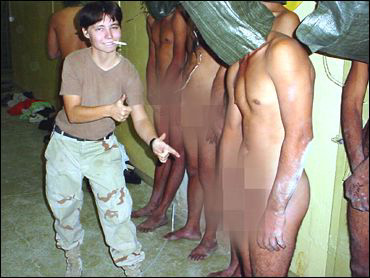
I didn't think beforehand about the route I'd take after visiting Fort Necessity, but it turns out that US 40 dumps you onto I-68 a few miles west of Cumberland, Maryland, which, it suddenly occurred to me, was only a few miles from Fort Ashby, West Virginia, home town of Lynndie England.  These days everybody knows Pvt. England by sight if not by name:  she's the female MP pointing at the genitals of Iraqi prisoners at Abu Ghraib with one hand while giving a "thumbs up" with the other.  Even after a day of dawdling down the highway, I was in no hurry to reach Bethesda, so I found the exit to West Virginia's State Route 28 and drove the thirteen miles to Fort Ashby, population 1354. [1380 per the 2010 census]

The community, about a mile square, spreads out from the single major intersection--Washington Street and Green Street-- which sports a solitary traffic light.  It has a gas station, a convenience store, a Dairy Queen clone, but no McDonald's (whether a town has a McDonald's is my rough-and-ready way of determining if it's a real town or merely a wide spot in the road).  After the prisoner abuse story broke in late April, a flurry of journalists showed up to evaluate Fort Ashby on the theory this would tell us something about Lynndie England, who had immediately become the poster child for all things nasty at Abu Ghraib.  Since the easy thing was to portray Fort Ashby as if it were so far removed from civilization that its residents had to pipe in daylight, that's the way the media tended to portray it.  And yes, there are a few double-wide trailers and maybe the odd junker on blocks in the front yard.  Mostly, though, the houses looked like this one:

http://www.homes.com/for-sale/fort-ashby-wv/

The house looks remarkably like the split-levels in my own subdivision, except that the shrubs are better pruned. 

My plan was to find a diner or, preferably, a bar where I could nurse a drink while eavesdropping on the local conversation.  Initially I was disappointed:  nothing suitable caught my eye.  I was about to leave Fort Ashby when I belatedly realized that at the southwest corner of the main intersection stood a ramshackle building that looked as if it might be a bar and--yep--turned out to be just that.  According to a newspaper article I found this morning on LEXIS-NEXIS, the place is called the Corner Club Saloon.  But since almost nothing in the article resembled anything I saw, I give no assurances the name is correct.
I was wearing Dockers, a button-down shirt, and a sport jacket:  much too dressed up for the Corner Club Saloon.  But nobody called me a dude, challenged me to explain what I was doing there, or offered to rearrange my face.  Instead the bartender served me one of those low-carb Michelob Ultras and said, in response to my question, that yes, he sold quite a few of them.  The guys to my right continued to shoot pool.  The women to my left continued an urgent discussion of something that very obviously had nothing at all to do with Iraq, Abu Ghraib, or Lynndie England.

As the minutes ticked by and I reflected with each new sip that $1.75 spent on a Michelob Ultra was $1.75 utterly wasted, I hoped against hope that a) the television above the bar from which CNN Headline News silently flickered would yield an image of the prisoner abuse scandal and, ideally, Lynndie England; and b) somebody in the bar would see it and comment on it.  No such luck.  But there was something homey and comfortable about the Corner Club Saloon.  After a while I didn't give a hoot about my original mission.  Instead I got another beer, looked over the menu, and ordered some chicken tenders for supper.

About the time that the chicken tenders arrived, the woman at my left turned to me and asked, in a neighborly sort of way that was neither challenge nor come-on, who I was.  It was just her way of including me in the group.  I gave her my name and said I was passing through on my way to Washington, DC.  We must have chatted for five or ten minutes before she asked, inevitably, what had brought me to Fort Ashby.  Any story I made up would sound so obviously made up as to be insulting, so I said, "Well, to tell you the truth, it was originally because I knew this was Lynndie England's hometown.  But I don't want to speak of rope in the house of the hanged, so we don't need to talk about that."

It turned out that my new friend, whom I'll call Kitty, did in fact want to talk about that--or, more precisely, about the town's recent experience with the media.  In fact, she wanted everyone within earshot to talk about it.  "Hey, do you know why he's here?  It's that Lynndie England story."


The men in the bar didn't immediately pick up on this subject, but the women did, especially Kitty and the Corner Club Saloon's other bartender, whose name was Colleen Kesner.  Colleen was married to the first bartender, Randall, and together they had owned the Corner Club Saloon for not quite a year.  Kitty wavered between wanting to talk to me and wondering if I was another reporter "out to do a number on us."  (A friend of Kitty's even patted me down in a joking-but-serious way, and there was brief consternation when she mistook my cell phone for a tape recorder.)  Colleen, on the other hand, gave me the benefit of the doubt and accepted me cordially on my own terms.

Although Lynndie England is far and away Fort Ashby's most famous persona, Colleen was more or less thrust into the role of Fort Ashby's civilian face, thanks largely to the efforts of a reporter named Sharon Churcher.  I have now read a number of press accounts of life in Fort Ashby and while they all lean far too heavily on the Appalachia stereotype--Fort Ashby is, in fact, a near-suburb of Cumberland and its population includes doctors, attorneys, dentists and accountants--only Churcher decided to engage in wholesale character assassination.

Here's the article Churcher wrote.  It was published originally in a New York tabloid, as I understand; this is the article as reprinted in the Sydney, Australia, Daily Telegraph on May 7:

Good ol' girl who enjoyed cruelty

POINTING crudely at the genitals of a naked, hooded Iraqi, the petite brunette with a cigarette hanging from her lips epitomised America's shame over revelations US soldiers routinely tortured inmates at Abu Ghraib jail near Baghdad.

Lynndie England, 21, a rail worker's daughter, comes from a trailer park in Fort Ashby, West Virginia, which locals proudly call "a backwoods world".

She faces a court martial, but at home she is toasted as a hero.

At the dingy Corner Club Saloon they think Lynndie England did nothing wrong.

"A lot of people here think they ought to just blow up the whole of Iraq," Colleen Kesner said.

"To the country boys here, if you're a different nationality, a different race, you're sub-human. That's the way girls like Lynndie are raised.

"Tormenting Iraqis, in her mind, would be no different from shooting a turkey. Every season here you're hunting something. Over there, they're hunting Iraqis."

In Fort Ashby, in the isolated Appalachian mountains 260km west of Washington, the poor, barely-educated and almost all-white population talk openly about an active Ku Klux Klan presence.

There is little understanding of the issues in Iraq and less of why photographs showing soldiers from the 372nd Military Police Company, mostly from around Fort Ashby, abusing prisoners has caused a furor.

Like many, England signed up to make money and see the world. After her tour of duty, she planned to settle down and marry her first love, Charles Graner.

Down a dirt track at the edge of town, in the trailer where England grew up, her mother Terrie dismissed the allegations against her daughter as unfair.

"They were just doing stupid kid things, pranks. And what the Iraqis do to our men and women are just? The rules of the Geneva Convention, do they apply to everybody or just us?" she asked.

She said she didn't know where her daughter was being held, but had spoken to her on the phone.

"She told me nothing happened which wasn't ordered by higher up," she said.

"They are trying to pin all of this on the lower ranks. My daughter was just following orders. I think there's a conspiracy. "

A colleague of Lynndie's father said people in Fort Ashby were sick of the whining.

"We just had an 18-year-old from round here killed by the Iraqis," he said.

"We went there to help the jackasses and they started blowing us up. Lynndie didn't kill 'em, she didn't cut 'em up. She should have shot some of the suckers."

Six soldiers from the 372nd are facing court-martial.

The commander of the prison service in Iraq, Brigadier-General Janis Karpinski, 50, has been suspended from duty and is expected to be charged.

Colleagues of the tough, super-fit officer last night described her as a woman with one mission -- to raise her own profile.

Sources also said soldiers at Abu Ghraib, where Saddam Hussein was held after his capture, were often drunk -- including when the shocking pictures were taken.

One colleague said: "Janis sees herself as making way for women to get to the top in the US Army. But many of her soldiers said she had been promoted beyond her ability because she was a woman.

"She was out of her depth and on a mission to raise her own profile. Now, she ll be forced to quit.

"She should have been aware what her troops were doing, but she wasn't."

Another soldier facing charges is Staff Sergeant Ivan Chip Frederick, 37, of Dillwyn, Virginia.

His father, Ivan Frederick, 76, said his son, an ex-prison guard, sent him a journal outlining the barbaric treatment of Iraqi PoWs.

He said his son was a scapegoat.

"He was unhappy with what he saw. There is no way Chip would do these things unless he was ordered to do," Mr Frederick said.

Pentagon officials have confirmed that other alleged incidents of torture under Brig-General Karpinski's regime were being investigated.

A military source said: "The word is that she was told it would be beneficial if the prisoners were willing to talk.

"Let's just say a blind eye was turned to certain events."
Colleen had a copy of the article behind the counter and showed it to me.  She said that the reporter had appeared at midnight on a Thursday or Friday night at the height of turkey-hunting season, when the place was full of hunters and so raucous with conversation you could barely understand a word anyone said to you.  Colleen had not yet heard about the prisoner abuse scandal, Lynndie England's role in it, and possibly even about the fact that England was a hometown girl.  (Others in the bar knew the England family; I'm not sure Colleen did.)  The reporter had to explain all these things to Colleen before she could ask Colleen to comment on them.

I doubt if the reporter could hear much of anything Colleen said in response, and in any case she spoke to Colleen only a few minutes.  I wound up talking to Colleen for three hours--far longer, she said, than any of the reporters who interviewed her.  The impression I had of her was of someone who habitually refrained from passing judgment, who was keenly aware of the complexities of living as a human being in this world, and who had a fundamental sympathy toward pretty much everyone.  Kitty, for her part, was emphatically of the opinion that nothing--not orders from a superior, not the transgressions of the prisoners--could justify what England and her comrades had done.  "Two wrongs don't make a right."  Nobody toasted Lynndie as a heroine.  No one defended her.  The most anyone did was to stick up for the young woman's parents, to say they were good people.
Colleen herself mainly seemed hurt and embarrassed to have been portrayed as saying anything remotely like:  "A lot of people here think they ought to just blow up the whole of Iraq . . . .  To the country boys here, if you're a different nationality, a different race, you're sub-human. That's the way girls like Lynndie are raised. Tormenting Iraqis, in her mind, would be no different from shooting a turkey. Every season here you're hunting something. Over there, they're hunting Iraqis."

I don't think Colleen said anything of the kind.  In fact, I doubt if Colleen said anything quotable at all.  Everything I heard her say had a reflective, tentative quality--a sort of principled refusal to draw conclusions before the facts were in--the kind of hesitation that leaves each would-be sound bite still-born.  This must have been maddening for a reporter on a deadline, besides which it largely undercut the point of doing a story on Fort Ashby.  The fact of the matter is, a visit to Fort Ashby sheds absolutely no light whatever on what transpired in Abu Ghraib, but when your editor has sent you to get a story and you've traveled hundreds of miles:  well, if the bar is loud enough and conversation is difficult enough, your ears can hear pretty much whatever you need them to hear.

The closest Colleen came to anything quotable was the following:  "Lynndie never came in this place.  She was underage.  But if she came in now I'd give her a hug, I'd buy her a beer, and then I'd ask her, 'What in the hell did you think you were doing?'"  Even this quote doesn't get at the heart of what Colleen was trying to say.  It needs context.  What framed the comment was Colleen's recognition that at 21 years of age, Lynndie had made a mistake from which her young life would quite likely never recover.  Most of us screw up, at least once or twice, in a big, big way.  Few of us screw up so publicly that the world forever sees us frozen in the worst moment of our lives.

I finally broke away from the Corner Club Tavern around 9:30 p.m.  As my headlights lit the highway back to Cumberland, I thought about the story that had brought Sharon Churcher to Fort Ashby:  the way in which American service personnel had abused and humiliated human beings in Iraq.  I doubt it ever crossed her mind that she, in turn, had abused and humiliated human beings in Fort Ashby.

Follow-up:  A search of Lexis Nexis this morning shows eleven hits for articles containing the terms "Lynndie England" and "Colleen Kesner."  The headline in the version published by the London Daily Mail is drawn directly from the quote attributed to to Colleen:  "Here if You're a Different Race, You're Sub-human. Tormenting Iraqis to Lynndie Would Be Just the Same as Shooting a Turkey."