Saturday, January 18, 2020

Millennium - Part 3

If American Christians viewed the Civil War through the lens of post-millennialism, American Christians for whom millennialism is still meaningful—mostly evangelicals—view the current political climate almost entirely through the lens of pre-millennialism. It is the opposite of post-millennialism. Whereas post-millennialism views the world as steadily getting better, pre-millennialism sees it as steadily getting worse, with a stream of signposts that signal we are in the “end times.”
The end times, as you will know if you’ve seen any of the “Omen” films, noticed the “Left Behind” series in the fiction section of a book store, or seen the movie version of the inaugural novel, will begin with the Rapture, when faithful Christians—by which is meant faithful evangelicals—will be taken directly to heaven, thereby avoiding both death and the seven-year hellscape to follow. The Antichrist will take over and life will become, let’s say, interesting. But at the end of seven years Christ will return, defeat the Antichrist, and save or damn the residue of humanity.
I’ve seen it argued that the Civil War influenced the turn from post- to pre-millennialism: it was hard to preserve a sense of an improving humanity amid the reality of a destructive war that killed almost 3 percent of the American population. But the main factor was a mainline Christianity that became increasingly earth-bound and bereft of the supernatural. In the late 19th century, mainline churches turned to the Social Gospel, a laudatory movement but one that was but little different from secular movements aimed at helping the poor and fighting back against the evils of monopoly capitalism and urban corruption. Seminaries began to teach “higher criticism,” which essentially dissected the Bible, revealing the Old Testament as a shotgun marriage of various Jewish theological perspectives and the Gospels not as reliable biographies of Jesus but as an evolving expression of the early Christian community.
Evangelicals responded with alarm, a rejection of intellectualism, and an insistence upon certain “fundamentals,” chief among them Scriptural inerrancy—which, while it might surprise many evangelicals to discover this, was something new. Though Bishop James Ussher might famously have dated the first day of Creation to October 23, 4004 BC, based on an ingeniously literal reading of the Bible, many educated Christians did not see Scripture in such terms. It was common to view some events set forth in Scripture as being symbolic and even to question whether certain books of the Bible belonged in the canon. (Martin Luther, for instance, considered the Letter of James to be “an epistle of straw.”)
Lest it seem as if I am trashing evangelical Christianity, let me pause here long enough to say that it has enormous strengths. These are well captured in Alistair McGrath’s “A Passion for Truth: The Intellectual Coherence of Evangelicalism” (1996), p. 22:
1. A focus, both devotional and theological, on the person of Jesus Christ, especially his death on the cross;
2. The identification of Scripture as the ultimate authority in matters of spirituality, doctrine and ethics;
3. An emphasis upon conversion or a “new birth” as a life-changing religious experience;
4. A concern for sharing the faith, especially through evangelism.
These attributes apply to many “mainstream” denominations as well, but evangelical Christians are among their most determined and least apologetic advocates.
But to return to pre-millennialism, evangelicals, to varying degrees, are convinced that we are living in the end times. They take pleasure in the fact that President Trump has followed through on a commitment, made by Congress years ago, to move the U.S. embassy in Israel from Tel Aviv to Jerusalem and are, at best, indifferent to the fact that this has hamstrung America’s ability to influence a peaceful resolution to the Palestinian question. It’s a move in the direction of bringing about the rebuilding of the Temple in Jerusalem—which would have to be done by eliminating the Dome of the Rock, one of Islam’s supreme holy places. This, in turn, would pave the way for all Jews to return to the Holy Land, which would set the stage for the Rapture; and for Jews to accept Jesus as the Messiah. (Evangelicals manage to combine sympathy for Jews with a basically anti-Semitic view that they must and shall reject Judaism.)
Pre-millennialism also helps to explain what, to many onlookers, seems inexplicable: the fawning adulation that some evangelicals have for Donald Trump, a man whose sexual history is problematic, to say the least; whose public persona is that of an unabashed bully; who knows next to nothing about Christianity, does not concede that he has ever sinned, and therefore is in no need of salvation. The president nonetheless has made good on election promises that address evangelical concerns, particularly the appointment of federal judges likely to overturn Roe v Wade and undo gay marriage.
Evangelicals have squared the circle by likening him to King Cyrus of Persia, a pagan used by God to liberate the Jews from the Babylonian Captivity. Earlier this month, at an “Evangelicals for Trump” rally, Miami megachurch pastor Guillermo Maldonado was explicit on this point. “Father, we give you the praise and honor and we ask you that he can be the Cyrus to bring reaffirmation, to bring change into this nation, and all the nations of the Earth will say America is the greatest nation of the Earth.”

Thursday, January 16, 2020

Millennium - Part 2


Book of Revelation, chapter 20, verses 1-6 (King James Version)
"And I saw an angel come down from heaven, having the key of the bottomless pit and a great chain in his hand.
And he laid hold on the dragon, that old serpent, which is the Devil, and Satan, and bound him a thousand years,
And cast him into the bottomless pit, and shut him up, and set a seal upon him, that he should deceive the nations no more, till the thousand years should be fulfilled: and after that he must be loosed a little season.
And I saw thrones, and they sat upon them, and judgment was given unto them: and I saw the souls of them that were beheaded for the witness of Jesus, and for the word of God, and which had not worshipped the beast, neither his image, neither had received his mark upon their foreheads, or in their hands; and they lived and reigned with Christ a thousand years.
But the rest of the dead lived not again until the thousand years were finished. This is the first resurrection.
Blessed and holy is he that hath part in the first resurrection: on such the second death hath no power, but they shall be priests of God and of Christ, and shall reign with him a thousand years."
***
But exactly when will Crist’s “thousand-year reign”—the millennium—arrive? Christians disagree. So millennialism comes in three flavors:
Pre-millennialism, post-millennialism, and amillennialism.
Let’s deal with the last one first. If you’re amillennial you don’t believe in a literal millennium, and you think Christians who do are pretty much wasting a colossal amount of time, intellectual pondering and above all, emotional energy.
But if you like the other two flavors you think amillennials Just Don’t Get It.
Nowadays pre-millennialism is the most typical form of thought among Christians who care about it (mainly evangelicals). It generally consists of a scenario in which, first, good Christians are “raptured.” [The Rapture is a reading of 1 Thessalonians 4:17. The concept originated only in the 19th century but I don’t think it became “a thing” (to use slang) until the publication of William E. Blackstone’s “Jesus is Coming,” published in 1878. Second, the doctrine postulates a seven-year period in which the rest of us get tattooed with the Mark of the Beast and have to contend with the anti-Christ, the spectacle of dogs and cats living together in sin, etc.
But in 19th century America pre-millennialists—who surely interpreted the war as a sign of the imminent coming of the End Times—were a small minority. The dominant view was post-millennialism, and by this reading the Civil War was an act of cleansing violence that would sweep away the remaining evil standing in the way of the Millennium, and the shit would hit the fan only after the Millennium. In other words, the general trajectory of history was that things were getting better and better and with just one more big push, Christ would return.
In other words:
Mine eyes have seen the glory of the coming of the Lord:
He is trampling out the vintage where the grapes of wrath are stored;
He hath loosed the fateful lightning of His terrible swift sword:
His truth is marching on.
Glory, glory, hallelujah!
His truth is marching on.
The third verse makes the case more directly:
I have read a fiery gospel writ in burnished rows of steel:
“As ye deal with my contemners, so with you my grace
shall deal
Let the Hero, born of woman, crush the serpent with his heel
Since God is marching on.”
Which of course is “The Battle Hymn of the Republic,” with lyrics written by Julia Ward Howe (1819-1910). Howe was an abolitionist and suffragist. The way I heard the story, in 1861 Julia Howe and her husband Samuel Gridley Howe (1801-1876) visited an army camp and heard soldiers lustily singing “John Brown’s Body,” which personally I think was pretty cool:
John Brown’s body lies a-mouldering in the grave;
John Brown’s body lies a-mouldering in the grave!
His soul’s marching on!
Julia Howe remarked that she liked the melody (which incidentally was ripped off from a hymn entitled “Oh! Brothers,” whose first line was, “Oh! brothers shall we meet you over on the other shore?”) But she didn’t like the lyrics. So she went home and composed better ones.
But there’s another story merely to the effect that she wrote it after meeting Lincoln. Which may be accurate but sucks in comparison to the way I learned it.
The lyrics were published in “Atlantic Monthly” in February 1862. The final verse in Howe’s original manuscript, however, wasn’t published:
He is coming like the glory of the morning on the wave,
He is Wisdom to the mighty, He is Succour to the brave,
So the world shall be His footstool, and the soul of Time
His slave, Our God is marching on.
Which is about as millennial as it could possibly be, although I imagine it was omitted not for ideological reasons but rather for reasons of space or because it seemed weaker than the earlier verses or maybe just because the previous stanzas were beating the theme ever more thoroughly to death and the Howe’s original last stanza was just plain overkill.
Not so incidentally, Julia’s husband Samuel Gridley Howe was one of the three members of the Freedmen’s Inquiry Commission, which examined the current state of freedpeople within Union military lines and offered recommendations about the role the government should (and should not) play in assisting freedpeople. Howe actually authored most of its two reports (preliminary, 1863; and final, 1864) the Commission sent to the Lincoln administration.

Friday, January 10, 2020

Millennium - Part 1

In the autumn of 2017 my daughter Chloe was for several weeks fascinated by Jesus of Nazareth—and small wonder: his story has fascinated believers and unbelievers alike for two millennia. We spent a lot of time reading her children’s Bible together and on the first weekend of November watched “Jesus Christ Superstar,” seated side by side on the couch in the den, with Chloe raising her hand every five minutes to ask a question. We’d pause the DVD. She’d ask the question, which was usually quite perceptive, and I’d answer it. So by the time I put her to bed on the night of Sunday, November 5, and had a chance to go work on the dreaded Promotion Book, I was so absorbed with Christianity that I decided just to go with that.
Previously I hadn’t given religion much thought—okay, any thought—in connection with the dreaded Promotion Book, which henceforth I will call “The Year of Decision: Lincoln’s America in 1864.” But I retrieved three books on the religious history of the Civil War from my library shelves and started going through them. I spent just enough time to see that this was a promising line of inquiry. Then I paused to read the “New York Times,” saw that 26 Christians had been slaughtered that morning in their rural Texas church, and that was that. I couldn’t re-focus on work.
The next day I itched to get back to work on “The Year of Decision”—I always enjoyed working on “The Year of Decision,” as opposed to the Promotion Book. But instead I had to deal almost constantly with other stuff. That evening I opened the writing journal I used to keep track of my progress on “The Year of Decision”—I keep a writing journal to support every important manuscript project, a practice I first developed while researching my doctoral dissertation. Reflecting on my lack of progress that day, I looked for periods of wasted time that could instead have been used to work on the book.
“The only three things I could have done differently were 1) not watch the evening news; 2) not call my brother this evening; and 3) not contact my pastor and offer to research how to deal with an active shooter situation in a church. After yesterday he had been thinking along similar lines, so he was happy to take me up on the offer. A quick Internet search revealed that there are quite a few sites that address this very issue, and by and large they appear sound. I was very impressed with one site that drew upon Dave Grossman’s work consulting with law enforcement on lethal engagement situations. Every would-be hero who imagines himself taking out the bad guy ought to read ‘On Combat’ and learn how powerfully a lethal engagement situation fucks with your mental and sensory perceptions. Only extensive and realistic training prepares you for that unforgiving minute.”
I wrote a couple of paragraphs about the problems involved with protecting my church against an Active Shooter—I quickly realized that the church floor plan gave us an excellent chance to employ lockdown/lockout tactics in the children’s Sunday school area, but that it would require lethal force to defend the sanctuary. Then I remembered the journal’s purpose.
“Well, I’m supposed to be thinking about the book,” I wrote. “Ok, so here’s one for you: Church safety when you are an African American church and there is a clear and present danger that Union soldiers will wait for Sunday services to end and commandeer your able-bodied men as they emerge from the building. Or worse—and this actually happened—invade your sanctuary and grab men straight out of the pews.” I inserted an illustration to make my point.
The African American men depicted were being impressed to construct fortifications to defend Nashville against Confederate General Braxton Bragg’s summer/early fall offensive 1862 that actually drove into Kentucky (triggering a similar frenzy to construct fortifications to defend Cincinnati). But while the event itself occurred in 1862, the engraving appeared in 1864—the year on which my book was focused.
I first heard the expression at a faculty meeting, although in what connection I’ve long since forgotten. “Maybe this isn’t an either/or,” one of my female colleagues said. “Maybe it’s a both/and.”
Since then, on several occasions in my life, I have found “both/and” to be a liberating phrase.
To those previous occasions, I now add this one: I’ve figured out a substantial aspect of the dreaded Promotion Book that requires attention, and this same substantial aspect is also an important element in “Struggle for Peace.” And this aspect is extensive enough to warrant a semester’s release time, because it will require travel to archives as well as a good deal of work at home.
So there seems a good chance the department will get what it deserves and I will get what I need.

Thursday, January 9, 2020

A Way Out of The Storm


This is a remarkable teaching that is well worth an hour of your time. Its basic thesis is that followers of Christ have to place the Gospel first, and that this entails, among other things, a refusal to participate in the toxic hyper partisanship that is especially in evidence on social media--that Christians are ambassadors for Christ and that if you indulge in hyper partisan links or memes, and people know you're a Christian, your action reflects on Jesus. In the minds of those who see it, their reaction is, "Oh, so this contempt for others is okay with Jesus."

The speaker--Ryan Lowery, a pastor at Xenos Christian Fellowship, a non-denominational church here in Columbus-- is talking to an audience of Christians, but the points he makes apply with equal validity to all of us.

Historically, republics live or die based upon the civic virtue of their citizenry--civic virtue being a willingness to look beyond one’s narrow self-interest and focus on what is best for the commonwealth. The politics of division, the omnipresence of fake news, the reflexive embrace of news outlets that reinforce our views and the dismissal of those which don't, have all created conditions in which it is almost impossible to exercise civic virtue, even if one understood its importance. What chance remains, then, must begin with a commitment to seeing other Americans as human beings, and to reject hateful stereotypes.

Lowery argues that it is okay to have a political point of view, but it cannot involve demonizing persons who hold different views. This demonization is easy if you deal in wholesale stereotyping, but more difficult if you take time to get to recognize the humanity of those with whom you disagree politically. I would argue that this, in turn, sets conditions in which a healthy political dialogue can be founded. I do not think that creating and sustaining that kind of dialogue is easy--in fact I think it will require a great deal from us--but without the recognition of a shared humanity it will be impossible.

I have only scratched the surface of Lowery's message, and I have placed it in a frame--that of civic virtue--which he does not mention. But I feel confident that the approach he outlines (which draws upon the insights of several books, secular as well as Christian) offers a way out to begin to emerge from the current mess, largely by refusing to take part in and reinforce it.

Wednesday, January 8, 2020

Things That Follow Us

I awoke the other morning to discover that I was still my father's son.
And this morning I awoke to discover that my department does not exist.
Not the department to whom it required saying Fuck You—mentally, to be sure, but in front of my readers/witnesses—in order to move forward with this project. Not the department that exists only in my—in my what, imagination? No, it isn't that. A moment's thought and I am sure it isn't that. Not imagination. And not quite in memory, either, because that's my next thought. But it’s something, I can feel that it is something, and it follows me.
But whatever it is, it is not within the building—a gigantic Lego block—that contains my office; nor is it the people within it, most of whom I do not see, almost literally do not see, except at faculty meetings. Although I suppose that if I wished, I could see them at the hopeful little tea times and annual picnics; or at the special presentations to be made—say the flyers that festoon the walls—on such and such an afternoon by such and such a distinguished and/or up-and-coming scholar.
Where I can’t see them is their offices, because they are either not present or too busy; nor in any of the coffee shops to be found all over campus, because of schedules that seem perpetually bereft of an available hour. Nor can I see them in the venue I would most like to: in their classrooms in front of their students, because most of these strangers whom I’ve known for years are astonishingly good teachers as well as first-rate historians.
Of course, come to think of it, if I did want to see them in their classrooms in front of their students, what could they do to stop me? Well, I guess they could in fact stop me: it’s their classroom and their choice. But I doubt they would.
There are things that follow us, some of them with names, and some without. But they don’t own us. Not yet.

Tuesday, January 7, 2020

Aw, Shit: Or, Guess Which One I Am?

Once upon a time a military history professor, in the course of lecturing on the naval reforms of the late nineteenth century, utilized an analogy to explain the symbiotic relationship between Admiral Stephen D. Luce and Captain Alfred Thayer Mahan. I was then a graduate student taking this particular course, “American Military Policy, 1607-1918,” for the second time, the first time having been eight years earlier as an undergraduate.
That first time I was taking it for a grade. This time I was just sitting in, but being far more grown up about it. As an undergraduate I had gotten an A—a slightly surprising outcome, given that I attended class maybe one third of the time. Or maybe not: over nearly three decades as a professor myself, I have seen more than one student manage the same feat. I never fail to resent it.
I thought the analogy so apt that not only did I write it down, I later incorporated it into my own lecture on the topic, back in the days when I had lectures that were (in this case, for example) eleven pages long, which, because it was in outline form, amounted to a word count of only 1,919. But that was still too long: you should commit the key stuff to memory and then walk around the classroom, giving the lecture without notes. You keep an eye on the students’ faces and when they start to look a little bored, you change things up. You quit lecturing and pause to tell a story, usually one that hits the topic of the day obliquely. This results in a conversational style that, judging by the comments in my Student Evaluations of Instruction (SEIs, of which probably more at some later date), most students seem to appreciate. The rest complain that Professor Grimsley digresses too much and should be fired.
Here is a vignette I nearly always use. The point of departure comes from a short story, “The Canterbury Ghost,” by Oscar Wilde, a nineteenth century British version of the wonderfully bitchy Gore Vidal (look him up: that’s what Google is for).
“I don't think I should like America.”
“I suppose because we have no ruins and no curiosities,” said Virginia satirically.
“No ruins! no curiosities!” answered the Ghost; “you have your navy and your manners.”

Ouch. About the Navy, I mean. But accurate, because in the 1870’s American warships were so antiquated that visiting Royal Navy officers were fascinated by their living museum quality.
In the 1880s that began to change, driven partly by an increasingly industrialized American economy but also by Luce and Mahan, who capitalized upon this opportunity to make the much-needed naval reforms.
In every reform movement there are typically two players, said the military historian whose course I was taking: “Mr. Inside,” and “Mr. Outside.” That is, some people work within the system while others remain outside, propagandize, and rally support without the burden of an institutional role. Luce, who founded the Naval War College, was Mr. Inside; and Mahan, whom Luce brought aboard as a professor, was Mr. Outside.
Given a choice between the two, I had much rather be Mr. Inside, if only because in academe Mr. Inside usually draws a much heftier salary. But by some combination of destiny and temperament, I have more often played Mr. Outside, which is an interesting role if you don’t mind being iconoclastic, which unfortunately I do. But when life hands you a particular role to play you play it. It’s better to strut and fret your hour upon the stage than to avoid strutting and fretting. Because the play has a limited engagement.

To the Last Man

It is an evening in early March, 1863. A Union gunboat stands snuggly anchored near the eastern shore of the Mississippi River. Technically it is still winter, but this is the state of Mississippi, and the evening air already holds the promise of spring.
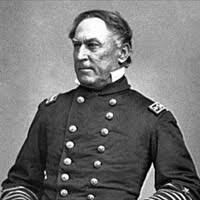
The gunboat is about to embark on a journey upriver, but preparations are not yet complete, and as sailors throughout the vessel bustle about to finish them, two men are seated in a cabin, deeply immersed in what is plainly a very serious discussion. One of them, grizzled in appearance, looks to be about sixty years old. He wears the uniform of a Union rear admiral—he is in fact the first officer in American history to hold that rank, an honor bestowed by a grateful Congress after his brilliant and nearly bloodless capture of New Orleans, the most populous city in the rebel South.
The other man is strikingly handsome and clearly younger—about fifteen years younger, to be exact. He wears the uniform of a Union major general. His own combat record is the inverse of the admiral’s, its highlight being a humiliating defeat made worse by an adverse strategic sequel.
Each man is, of course, well aware of the other’s reputation. But the stark contrast means nothing. The only relevant fact is that the two men bear joint responsibility for an imminent, important military operation.
The older man happens to be David G. Farragut, who will one day be memorialized by an imposing statue in the center of Farragut Square in the nation’s capital. He is a career naval officer who has almost literally known no other life, having entered service as a midshipman at the age of nine.
The younger man is Nathaniel P. Banks, bereft of military service until the outbreak of the war, but with a political career behind him that, in terms of success, handily outstrips that of Farragut’s own pre-war career, which is so straightforward it’s scarcely worth mentioning.
But at age 32 Banks had won election as a representative in the Massachusetts state legislature. Just two years later he took up the gavel as Speaker of the Massachusetts House of Representatives. Two years more saw him win election as a representative to the U.S. Congress, and barely a year later, at age 40, through a combination of luck and skill, he became Speaker of the House, among the youngest Speakers in American history. He the won three terms as Governor of Massachusetts and easily won re-election three times. Then in 1860, at 44, he traded politics for a more lucrative career as resident director of the Illinois Central Railroad. A year later that career ended abruptly with the outbreak of the Civil War.
Banks almost immediately vaulted into the rank of major general of volunteers, an utterly bizarre development by present-day standards, but then few present-day standards applied to the early days of a crisis utterly unprecedented in American history. President Abraham Lincoln firmly believed that success depended upon strong public support for the Union cause, and a good way to ensure this was to make generals of men like Banks—in the case of Banks specifically to ensure the allegiance of the populous state of Massachusetts. His extensive political connections, acquired during the course of his meteoric political career, were a nice bonus.
There might have been a second reason to promote Banks. The Civil War was precisely that—a civil war—and as Union armies conquered Confederate territory their very success would require men equal to the problematic task of administering territory that must, after all, be restored to the Union, and that restoration was the entire point of the Union war effort. The complexity of this task should not be underestimated. A brilliant admiral like Farragut, although an expert at navigation at sea, would not have the slightest idea how to navigate the swirling political waters of wartime administration.
Banks, like Farragut, is now memorialized by an equally imposing statue in the heart of Boston. The statue memorializes his peacetime political career, of course, but with equal validity it could memorialize his service to the Union as military administrator, which in its own way would contribute as much to eventual Union victory as Farragut’s naval genius.
But the moment of that victory, as the two men confer about the impending operation, is unknowable. It may lie two years in the future, or five, or perhaps a whole decade. All they know is that the United States has been torn in two by a political disaster.
It was a political disaster that a few Americans had threatened it, or warned about it, for decades. But few really believed would actually happen, not even during the 1850’s, a decade that had seen a number of major crises centered on one basic question: was the American republic a free republic with pockets of slavery, or a slave republic with pockets of freedom?
Politicians showed themselves unable to resolve the question through the ordinary give-and-take of politics. A famous historian will one day dub them, collectively, as “the blundering generation.” Banks, strictly speaking, is a member of that generation. Certainly he saw much of the blundering at close range, thanks to his years in Congress.
Of one thing, however, both men are certain: the Union must be restored.
And as they uncork a bottle of champagne and share a glass or two, Farragut articulates the price to be paid if necessary.
“What matters it, General, whether you and I are killed or not? We came here to die. It is our business and must happen sooner or later. We must fight this thing out until there is no more than one man left and that man must be a Union man.” He briefly lifts his glass: “Here’s to his health.”